Hugo’s Ego: The Second
Hugo Werther. A man of large learning. And a man curiously given over to his vanities and conceit, these negative qualities so oddly filtered through his eccentric nature, as to render his actions and life most worthy of account on these pages… Let us, then, peruse the life of this strange man together; and, though I for one have already formed an opinion on his character, those not formerly acquainted with his person have now the pleasant opportunity of so doing…
A man is a slave to the dictates of his ancestors’ doings… Whatever a man may do in his life, whatever he may strive for, live for, die for, he cannot help but take some part of what has already been done by those before him and place it into his own actions…
His thoughts, his acts, his plans- all are tainted by a touch of unoriginality stemming from his predecessors. For some, this is a biological law worthy of their approbation. For others, it is a curse and a blight on their existence…
For Hugo, it is a curious mix of these two consequences… For the most part, he lives unaware of what parts of him are wholly his own, and which are preconceived, imparted, imprinted…
His mind is much occupied with the lives, thoughts, and activities of those he reads of; and his outward forces are inclined towards the eager approximation of the subjects he deems worthy by means of his pen and his tongue…
However, this does not mean that the history and subsequent influence of Hugo’s forbearers are of no consequence to others; nor does it mean that such considerations should not figure in their awareness… Hence, the author of this work seeks to bring before you a history, nay, not merely a history, but an understanding of those individuals who have partaken of earlier pieces of the world’s history than Hugo, whilst later coexisting with him for a time…
Edward Ellington Werther: That is the name of the man to whose procreative power Hugo became a victim…
If the Werther’s had been so unfortunate as to have a coat of arms attached to their name, it is likely, due to certain rumours surrounding Hugo’s origin, that the application of the bend sinister to this emblem would not likely be inaccurate…
Due to the intoxication of the conscience in our modern age with the sweet yet fleeting wine of immorality, a man who is a mystery does not force itself too intensely upon the minds of those surrounding him- though it could be said that this point in Hugo’s history does provide his detractors with an additional, more immediate means of insult through one term- here emitted for reasons of delicacy…
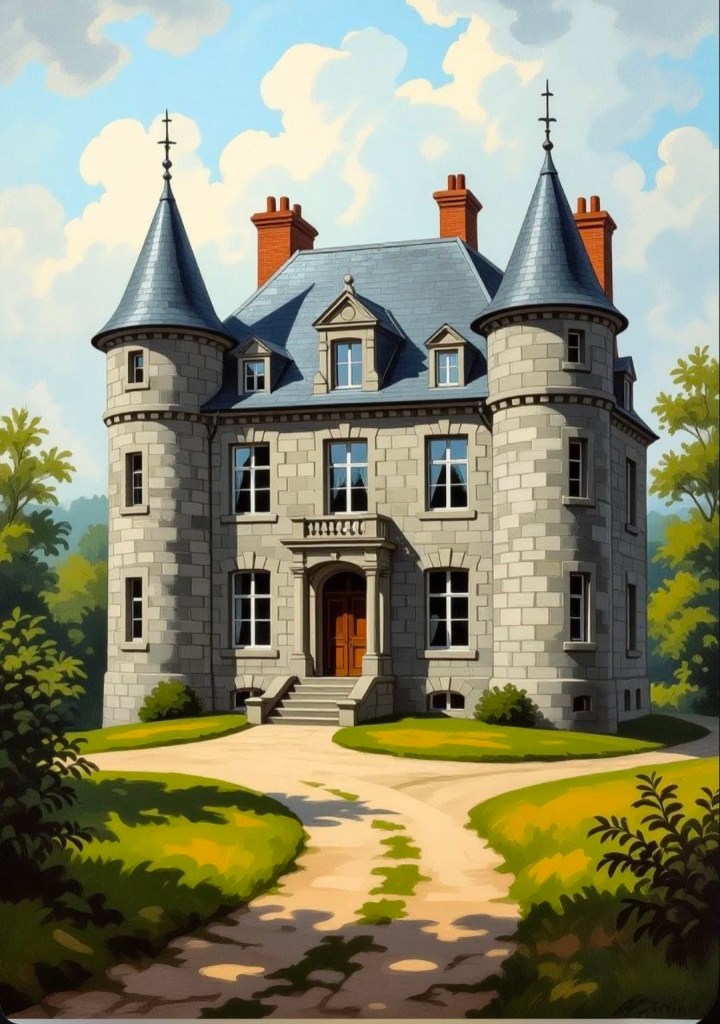
Hugo’s father lived on the family estate, the same place in which Hugo may be found today. Edwards’ father, Arnold Werther, was a rich man who brought this grand estate into existence with the greater part of his wealth; soon after its completion, he died exhausted by debts, scandal and the taxing knowledge that his life was a great success…
It is of note that, upon Arnold Werther’s death, a short poem was published regarding his demise in a prominent newspaper of the time; this piece was penned by a journalist and minor poet, who, during Arnold’s political career, had made himself into an opponent and detractor of this man’s ways and activities… This spirit of opposition was not altogether unjustified in the minor poet’s case, for Arnold was a man who engaged in various dubious and unworthy schemes, in order to enhance both his political career and his own personal funds… Sadly for justice, its demands were never fully served during Arnold’s life, for his errant acts were never raised above the realms of rumour, speculation, and angry accusation. Still, rumour is a powerful force, and many were the foes and antagonistic forces which rallied themselves against Arnold Werther.
The aforementioned poem is a source of some discomfort for the Werther family, and every attempt has been made on their part to suppress its further publication and circulation… For the interest of the reader, this short expression of dubious wit has been included here:
A Word On The Death Of Werther
Whither has Werther withered?
To a harp in heaven
Or the fires of hell?
His life was full of scandal
His death is full of joy-
His soul a sulfuric smell…
A note of antagonism towards Arnold Werther within this work will likely not escape even the most imperceptive of readers, and indeed some persons more favourably disposed towards Arnold did make comment upon its rather distasteful brand of humour; however, the work was praised by a great many prominent and noteworthy persons of the time, and it is fortunate for the Werther’s that this acidic obituary did not work its way onto the gravestone of Arnold Werther…
Like his father, Edward Ellington Werther pursued a career in politics, and, it should be said, achieved a measure of success in this endeavour, thanks to certain qualities vital and common to those involved in this sphere of activity… Chief among these qualities was his aptitude for statements, written or spoken, which, though doubtless running parallel to the solid lines of truth in small, subjective ways, could be found, when considered in a more objective, practical fashion, to be running beside the furthest extremes of a very unkempt garden path… This tendency towards the oblivion of truth gave rise to a great many victories and gains in the life of E.E. Werther, and these victories of income and fame were only surpassed by his defeats in debauchery and scandal…
Thus, in time, like his father before him, Edward came to an end surrounded by contention and unsavoury remarks… It was not long before this sorry demise that Hugo Werther came forth into the world…
Though it would seem that Hugo was not a result of the appropriate bond occasioned by the procedure of marriage, it could still be said that his “mother” had more of a hand in his upbringing than his father. Edward was married to a woman by the name of Amelia Werther, a quiet, humble sort of character whose presence in Edward’s mind and heart was soon eclipsed by the bright, giddy lights of dissipation, and the loud, easy women who moved about in this bedarkened realm… Amelia was somewhat plain in appearance, yet possessed a certain beauty, not likely apparent to men such as her husband, of a docile, peaceful kind- a sort of beauty resulting from a suggestion of fine things to be discovered within her person, and not of the kind to be discerned by a mere passing glance.
During Hugo’s earliest years and, subsequent to the death of his father, Amelie Werther caught the attention of a middle-aged, serious-minded tutor, who took both Amelia and young Hugo under his wing. Rendering financial aid to Amelia and educational aid to her “son”, this tutor (whose name was John Wilmer) had a large and obvious effect upon the later character and direction of Hugo Werther. For more than a decade, he rigorously instructed Hugo in matters pertaining to literature, literary history, the art of writing, philosophy and world history. Wilmer’s methods were effective yet also a little strict, rigid, and domineering, so that Hugo passed his childhood acquiring a fearsome knowledge of a great many things, yet, in the vigorous act of acquiring this knowledge, his character underwent certain twists and aberrative turns which contributed to his later eccentricity…
A certain lack of social normality and awkwardness crept into Hugo’s expansive soul, and, though Hugo never felt a great aversion to social interactions, his oddities and quirks were quickly realised by those making his acquaintance.
Amongst an eccentric man’s friends, of course, there are to be found a great many eccentric men, and Hugo acquired many curious companions who, generally unrepresentative of humanity at large, gave Hugo a greater sense of being at home in this world…
Though John Wilmer had an affection for Amelia Werther, his career as a tutor and his intellectual pursuits inhibited a more concrete and legally realised relationship existing between them, and due to his frequent travelling, during which he spent long periods away from Amelia in foreign lands such as India or Africa, rendering tutelage to the offspring of rich British persons who had taken up residence there, he did not spend a great time with Amelia, their communication often consisting of letters. Young Hugo frequently accompanied his father’s successor to these foreign parts, soaking up instruction through his eyes from different cultures and the ways of the world. John Wilmer had a strict regime of education in place for Hugo, which he was inclined to observe, even when his instructor was not physically present.
When Hugo was in his eighteenth year, John Wilmer fell seriously ill after returning from a trip to an African region, and, his illness sadly proving stronger than the attempts made against it, he perished, leaving Hugo alone with Amelia. Their time together, however, had not been without lasting effect, and Hugo’s love for knowledge, wisdom and study remained, even as the one who had imparted it to him did not. Hugo continued to study and learn according to his own inclination, for John Wilmer had impressed upon him the idea that life was a series of secrets wrapped up within the world of literature, and that study and reason were the key to their unravelling…
The death of her vague yet valuable lover caused great grief within the heart of Amelia Werther, and she concluded her days in a state of relative isolation, tucked away in the Werther estate. Over time, this estate had begun to suffer somewhat as a result of a lack of funds, and many parts of its domain longed for repair and rejuvenation… (In fact, there was a time when the place was shunned by most visitors, as they feared that perhaps one of its towers might topple and crush an unfortunate below; or that some part of the mighty ceiling, clearly in need of attention from all who went inside, might bring about a premature disembarkation from the shores of the living…)
Amelia died when Hugo had recently encountered his thirtieth year, and this event greatly pained Hugo, as he had grown to be a sort of protector and guardian of his “mother” as she lived her lonely life at the estate. For a time, Hugo entered into a state of extreme isolation, focusing his mind more than ever on his studies and literary efforts. This period of isolation further added to Hugo’s social peculiarities, and inculcated within him a greater love for solitude than he had known before.
In addition, Hugo had within him a certain charming vanity, a daring yet almost pleasing conceit, which stemmed partly from his dubious ancestors and also from his deep learning and long periods spent by himself; these parts of his nature found little favour with many persons, but there were some who, having more patience, more insight, or perhaps, more in common with Hugo, found these qualities somewhat appealing and to have an irregular sort of charm…
In his early forties, he met a certain woman by the name of Georgina Loughton, and, in time, her name became Georgina Werther… This unexpected occurrence came as some surprise to those few who knew Hugo, for it had long been assumed that Hugo had, at some early stage in his life, had taken the hand of literature and walked it down that aisle which leads to matrimony, and that, besides this bride of many an esteemed scholar, he had chosen solitude to be his lover…
Hugo had first encountered this worthy future Werther during a rare visit to town.
He had been in need of some supplies- various foodstuffs and other trivial matters- and had been promptly taken in hand by Georgina, the shopkeeper, who handled Hugo in a fashion almost motherly, quickly assuming a right to order him about the shop and instruct him on just what he needed, how much and of what kind… Many men would perhaps object to this nature in a woman, but, to Hugo, she seemed… strong, solid, and certain in her aspect and bearing. Rapidly coming to the conclusion that this was something he was missing in his life, Hugo began to attach himself more and more to this woman. Coincidentally, Miss Loughton took it upon herself to guide and direct Hugo more and more in matters domestic and dietary, and, as Hugo’s visits to town became more frequent as a result of his interest, she had all the more opportunity to do so…
It was the perfect match… Hugo needed a strong, understandable woman, and Miss Loughton needed a loyal subject, to whom orders would be given and promptly obeyed. Indeed, it can be observed that many a lasting and unbreakable match has been formed on similar or even identical principles, and that, though not without its occasional tensions, such a bond often achieves a pleasing degree of permanence, its two parts firmly glued together by need, obedience, and a respect for authority…
Hugo Werther and Georgina Loughton were married, and the bride’s parents, though not exactly wealthy, gave Georgina a modest sort of dowry which enabled Hugo to enact some much-needed repairs upon the Werther estate. These repairs, however, were often temporary and not comprehensive, and though they succeeded in making the Werther estate a little less fatal, there remained much that would soon need attention. The estate was at least made presentable to the eye, and visitors could now enter the grounds and approach the great structure without any great fear welling up within them.
Hugo soon settled into a way of life which struck the right chord of harmony between his own wishes and the rigid domestic ideals of Mrs Werther, and though they doubtless had their moments of discord, these times were all a part of a relatively stable and typical marriage, rather than an event beside it which could result in its termination.
And now, my dear reader, you must permit me to draw a dignified close to this insight into the history of Hugo Werther, and to prepare you for our next chapter in this examination of a curious life. Indeed, in this next chapter, we will gaze upon the fine yet neglected architecture of the Werther estate, and increase our knowledge of its design and appearance. Too, we shall absorb some of the details of Hugo’s personal matters and affairs, and also witness an event of some note in regard to the fragility of Hugo’s domain of grey stone…
But, until the time when the disclosure of this narrative becomes appropriate, I must bid my reader a fond farewell, and wish them well, in this great catacomb, this great and confusing fog, this be-dazzling maelstrom, which we know and fear as life!-
For I am, as you may know, your humble servant, the author of this work:
Daniel Macintyre (Copyright Daniel Macintyre protectmywork.com 03/12/2025)

 Scribbles
Leave a reply to daphnekingcome1944 Cancel reply